

THE LSH LAND & DEVELOPMENT PERSPECTIVE ON DELIVERY, PARTNERSHIP AND THE EVOLVING HOUSEBUILDING MODEL.
The UK is entering a decisive decade for affordable housing. Long term grant commitments, a new investment platform through Homes England, and planning reform together create an opportunity to convert policy intent into delivery at scale. Making the most of this moment requires pragmatism and a focus on getting shovel ready schemes moving, structuring partnerships that genuinely share risk and reward, and adapting the housebuilding model to higher standards, modern methods and a more diverse tenure mix.
At LSH, our priority is turning this policy window into homes on the ground by aligning public and private capital, unlocking complex land, and enabling Registered Providers (RPs) and local authorities to deliver faster and more affordably, without compromising quality or long term stewardship.
There now exists a real opportunity to accelerate delivery as the policy landscape has shifted from short term programmes to decade long frameworks. The Government’s £39bn, 10 year Social and Affordable Homes Programme (SAHP), beginning in 2026/27, is designed to deliver the biggest supply uplift in a generation. Government statements underscore this as “the biggest long term investment in social and affordable housing in recent memory”.
In parallel, Homes England is being equipped with a new National Housing Bank, a publicly owned subsidiary with c.£16bn of public financial capacity and a mandate to unlock more than £50bn of private capital over the decade, using debt, equity and guarantee products to support higher need, lower viability sites. The Agency’s stance is direct, it will back schemes that are deliverable now and scale long term regeneration pipelines over time.
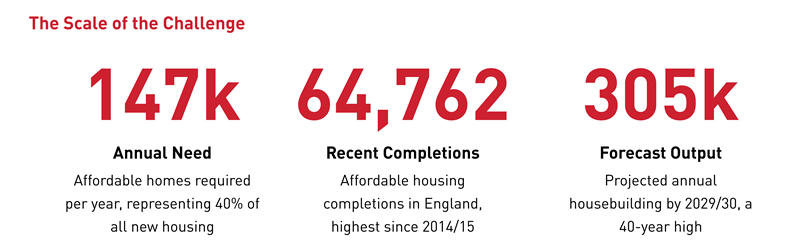
From a market need standpoint, the case for acceleration is clear. Evidence suggests that approximately 40% of new homes in England need to be sub market tenures, around 147,000 homes per year, to meet affordable housing need, far above recent outputs. Meanwhile, OBR forecasts show that even if overall housebuilding rises to roughly 305,000 homes annually by 2029/30, a 40 year high, this will mainly stabilise rather than transform long term affordability ratios.
Recent delivery figures underline the gap. Homes England delivered 38,308 starts and 36,872 completions in 2024–25, an improvement on the previous year, while England as a whole recorded 64,762 affordable housing completions, the highest since 2014/15. Despite this progress, outputs remain below the levels implied by assessed need.
Government intervention continues through the New Homes Accelerator, expected to unlock at least 125,000 homes by providing specialist planning and technical support to stalled or complex sites, and improving coordination between LPAs and statutory consultees.
FROM OUR EXPERIENCE THIS IS WHAT ACCELERATES DELIVERY NOW? 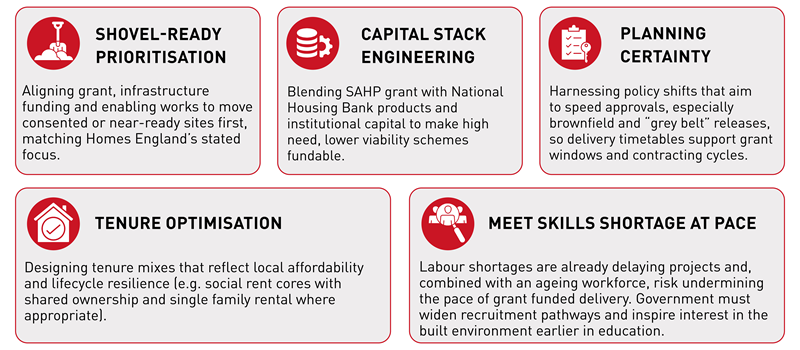
 Dinny Shaw, Head of Planning at Places for People (PfP), one of the UK’s largest placemaking and regeneration organisations, highlighted their response to the skills challenge, “PfP Thrive is equipped to meet this demand and can contribute to more trained professionals. While gov-ernment is doing the right thing with its focus on apprenticeship funding, it can do more by sharpening its focus on diversity in the construction sector, recruiting from ‘non-traditional’ demographic groups such as women. It can also go further upstream to cultivate more interest in the built environment at earlier stages of the education system.”
This acceleration comes from disciplined sequencing of bankable development sites, target-ed use of grant and guarantees to de risk the middle of the pipeline, and early viability conver-sations so delivery plans match real world constraints.
Dinny also explained how PfP collaborates with partners, “At Places for People we create mixed use communities with homes in a variety of sizes and tenures which support inclusive, enduring and sustainable places whilst also supporting delivery of new homes at pace.”
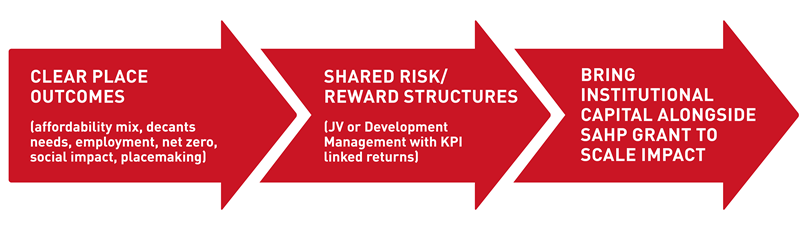
In our opinion this decade will be defined by partnerships, not transactions. Homes England’s strategic plan forecasts agency supported completions almost doubling from c.40,000 in 2025/26 to over 80,000 by 2029/30, driven by deeper collaboration with mayors, local leaders and high performing delivery partners.
Evidence shows that these partnership models work. Two thirds of organisations surveyed in the legal sector are already in strategic partnerships, with 76% planning to expand partnering over the next two years to unlock complex urban sites and attract private capital. Practical guidance on council/RP collaboration similarly shows that shared leadership, land strategies and coordinated allocations increase output and improve outcomes for vulnerable households.
Dinny approved of the government’s recent legislative changes and what this means for the housing market, “We have welcomed the governments planning policy and legislation reforms in the last 18 months which have supported more land being released for new homes and communities alongside investment in LPA resourcing. Focus now needs to be on resourcing LPA’s and statutory and local consultees to speed up decision making alongside local government reorganisation and devolution.”
Evidence shows these models work. A recent legal sector survey found two thirds of organisations are already in strategic partnerships, with most reporting success and 76% plan to expand partnering over the next two years, particularly to unlock complex urban sites and draw in private capital. Meanwhile, practical guides to council/RP collaboration highlight how shared leadership, land strategies and allocations approaches increase output and improve outcomes for vulnerable households.
LSH HAS IDENTIFIED WHAT DRIVES THE MOST EFFECTIVE PARTNERSHIPS AND PROVIDES JOINT VENTURE ADVISORY SERVICES FOCUSED ON:
The housebuilding model is adapting to long term challenges. Higher standards, including the Future Homes Standard and Awaab’s Law, are resetting baselines although they increase upfront costs, they reduce lifecycle risks and improve resident outcomes. The direction is unambiguous and providers are reorganising around it. MMC is shifting from pilots to platforms, supporting productivity, quality assurance and programme certainty, with the industry undergoing what has been described as its “most significant transformation in decades”. Developers are also broadening routes to sale and hold, working more creatively with RPs, for profit providers and long income capital. Outlooks for 2026 suggest increased development activity supported by SAHP, a CPI+1 rent settlement, and the National Housing Bank, while refinancing pressures push more JVs and stock rationalisation.
Overlaying these shifts is a plausible supply uplift if planning reform delivers. OBR forecasts show that housebuilding could reach approximately 305,000 homes per year by 2029/30, the highest level in 40 years, if reforms translate into faster approvals, more available land and greater certainty for investors.
In our view, the new housebuilding model is partnership led, platform enabled and standards driven. It blends grant with guarantees and private capital, uses MMC to stabilise programmes, and optimises tenure to meet local need while keeping schemes bankable through the cycle.
WHAT THIS MEANS FOR CLIENTS AND PARTNERS:

At Lambert Smith Hampton, we bring together Land Agency, Strategic Land, Viability, Planning, Living and Programme Advisory to accelerate affordable housing delivery and structuring partnerships that withstand scrutiny and deliver homes sooner. We fully align with Homes England’s call to action that it will “relentlessly focus on maximising delivery of new homes and communities now”.
Our role is to make this vision a reality for developers, local authorities, RPs and investors in the places that need it most.
Thank you to Dinny Shaw at Places for People for her invaluable comments and contributions, which helped shape the perspectives shared above.
Related Content


REGISTER FOR UPDATES
Get the latest insight, event invites and commercial properties by email