

From hope to delivery: reinventing Britain’s town centres
The Government’s 90-page Hope on the High Street strategy was published alongside the 2026 Autumn Budget in August and outlines measures to rejuvenate centres, tackle empty shops, support independent traders, and back retail, hospitality and leisure businesses. The challenge now is how to turn ambitions into delivery.
Our high streets are evolving. Online shopping, dynamic working patterns and consumer behaviour, rising costs and the loss of traditional retail anchors have fundamentally changed the roles and economies of many of Britain’s high streets and town centres.
LSH and Revo’s annual research has tracked this transformation since 2019 and consistently highlighted one of its clearest symptoms: most of our centres have too much retail space (Shaping Tomorrow’s Places 2025).
That does not mean high streets are becoming irrelevant. Quite the opposite. More than 4.4 million people work in businesses on Britain’s high streets, while retail and hospitality together account for around 7% of UK economic output. High streets remain places where people work, live, meet, access services and identify with their communities.
The challenge is how to reshape our centres as more diverse, attractive and resilient places where people want to live, work, visit and spend time.
Building on what has gone before
The Government’s Hope on the High Street strategy does not start from a blank sheet of paper. It brings greater coherence to an evolving programme of funding, policy reform and intervention. That includes the Pride in Place Programme, now backed by up to £5.8 billion over ten years across 284 communities, alongside the separate Pride in Place Impact Fund for more immediate improvements to high streets, community facilities and public spaces.
The new £210 millionCommunity Assets Programmeannounced in the Budget adds a further layer. The package is designed to bring underused and at-risk local assets back into productive use and strengthen community ownership. It comprises a £125 million Derelict Buildings Fund, £65 million for community ownership, £10 million for High Street Rental Auctions and £10 million for a Regional Co-operative Development Programme.
The revised NPPF further complements these interventions by strengthening the planning framework for high-street adaptation and the “town centres first” approach to development. The Government is also giving local leaders greater influence over problem uses and how high streets evolve through devolution and plans for local government reorganisation.
The significance of Hope on the High Street lies less in any single new initiative, and more in bringing funding, planning, property intervention, community powers, business support and devolution into a more coherent approach to place.
The Government organises this around six pillars which provide a useful framework for assessing both the opportunities and the challenges for our high streets and town centres.
1. Active leadership and management: giving people confidence
The first pillar recognises something regeneration practitioners have long understood: successful places rarely happen without strong leadership, an agreed vision and effective stewardship. In response, the Strategy strengthens the tools available to local leaders and communities. Possessing powers, however, is not the same as having the capacity to use them.
The challenge is therefore to combine local knowledge and community involvement with the commercial, planning, property, funding and delivery expertise required to turn a vision into action.
This matters increasingly as devolution changes the geography of decision-making. Strategic Authorities and Mayors can coordinate transport, investment, infrastructure and growth across wider areas, but local centres still require strong local leadership, community buy-in, and delivery capability.
Devolving responsibility without sufficient capacity risks simply devolving the problem.
2. Strong businesses, anchors and amenities: creating reasons to visit
The traditional department store may be disappearing from many centres, but the need for anchors has not.
The Strategy envisages a much wider range of activities and uses capable of generating footfall, including healthcare, education, libraries, public services, markets and community facilities. It introduces a “High Streets First” principle for the public estate, supported by Local Asset Management Plans and Place-Based Business Cases, so that decisions about public property can contribute more explicitly to regeneration.
This is an important evolution. Healthcare, education and civic services should not simply be viewed as alternative occupiers of redundant shops. They can become economic anchors in their own right.
LSH’s work in Corby and Tilbury provides two examples. In Corby, our advice to the Council and Town Board helped secure almost £20 million through the Towns Fund. One resulting project transformed a prominent building that had stood vacant for more than ten years into the town’s first dedicated sixth-form college. In Tilbury, LSH helped develop the Town Investment Plan and subsequent business case for the new Youth Zone, introducing another form of community infrastructure capable of generating regular activity and footfall in the town centre.
The lesson is straightforward: diversification is not about managing retail decline. It is about creating a new generation of anchors, introducing new sources of demand and giving people more reasons to use town centres.
3. Culture, leisure and entertainment: creating reasons to get together
As shopping has moved increasingly online, successful centres must compete on attributes that cannot easily be replicated digitally: experience, social interaction, culture and distinctiveness.
Government evidence suggests around 31% of people now primarily visit high streets for social purposes rather than shopping. Markets can increase footfall by between 15% and 27%, while large live-music events can generate more than £100 of additional local spending per attendee.
That explains the Strategy’s emphasis on culture, leisure, hospitality, markets and the evening economy and its associated investment in cultural, music, hospitality and leisure infrastructure.
This also aligns with LSH/Revo research. Hospitality, culture, public realm and experiences beyond traditional shopping have consistently featured in respondents’ priorities for more successful and resilient centres.
Figure 1: Diversifying our town centres beyond retail
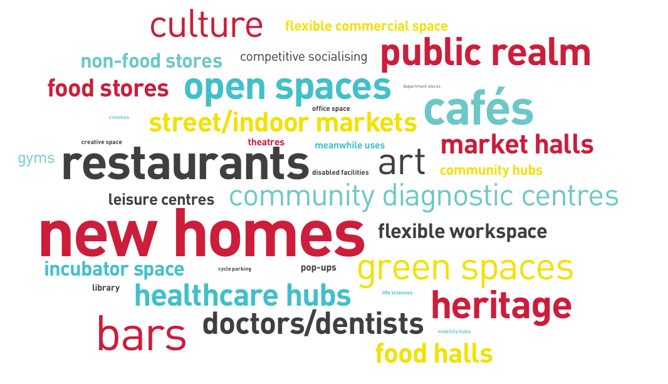
Source: Shaping Tomorrow’s Places 2025.
The future competitive advantage of many town centres will therefore come not from how much retail floorspace they contain, but how compelling they are as places to spend time.
4. Easy access and connectivity: creating reasons to explore
Successful centres also need to be easy to reach and easy to navigate.
The Government places walking, cycling and public transport alongside accessible streets, servicing, parking and connections with surrounding communities. Around 87% of households in England can reach a high street within 20 minutes by public transport, but this varies considerably between places.
Accessibility is therefore not simply a transport issue. It influences catchment, footfall and ultimately commercial viability.
Well-designed streets, public spaces, green infrastructure, transport interchanges and wayfinding can encourage people to stay longer and move more widely around a centre.
Regeneration strategies that treat property, planning, public realm and transport separately risk missing how these interventions reinforce one another.
5. Safe, clean and welcoming: creating reasons to return
A centre can have the right mix of uses and excellent connectivity but still struggle if people do not feel confident using it.
The Strategy therefore treats safety, cleanliness, design and management as fundamental components of economic regeneration. Measures range from neighbourhood policing and organised-crime enforcement to shopfront design, greening and stronger powers to tackle problem premises.
The Government is also clear that visible vacancy and dereliction matter. They affect not only individual buildings but confidence in the surrounding place.
That is why the £125 million Derelict Buildings Fund and £10 million High Street Rental Auctions programme are potentially significant. The former is targeted at buildings that are long-term vacant or derelict, while the latter helps councils intervene where commercial premises have remained persistently empty.
HSRAs will not be appropriate for every vacant property. LSH’s work on the emerging process highlights the importance of understanding local market and occupier demand, targeting intervention where it can have most impact, and engaging with property owners before resorting to the full statutory process. Where an auction is appropriate, LSH’s specialist Town Centre & Economic Regeneration team and other advisers can support authorities with market assessment, property marketing and the auction process.
This is fundamentally about stewardship. Successful regeneration requires active management of buildings, streets and spaces long after the initial capital project is complete.
6. A place to call home: creating reasons to move in
Housing is perhaps the most significant opportunity to fundamentally reshape many centres. More residents can provide regular demand for shops, cafés and services, bring activity outside traditional retail hours and unlock redundant upper floors and commercial sites.
LSH is advising on the viability, planning and delivery of new homes, including affordable housing, in centres and communities across the country. This includes securing permission for 225 homes alongside flexible commercial and community uses at Emery Gate in Chippenham, which will help transform a failing traditional shopping centre into a vibrant mixed-use scheme. We are also helping to shape and deliver new, diverse centres and high streets for growing communities. For example, LSH is advising Homes England on the delivery of new homes and a new town centre for Northstowe in Cambridgeshire.
But housing is not necessarily the easiest answer to replacing redundant retail space and regenerating our centres. The places where transformation is most urgently needed are often those where viability is the greatest challenge due to a combination of lower residential values, high construction costs, complex sites, fragmented ownership and planning constraints.
This creates a regeneration paradox. A recovering investment market does not necessarily resolve it: stronger assets and prime locations will attract institutional capital, while weaker secondary and tertiary centres, with structural vacancy and substantial capital requirements, remain much harder propositions.
From hope to delivery: what does this mean in practice?
In conclusion, the six pillars provide a compelling framework for creating successful high streets and centres. Its six pillars should not be viewed as separate policy programmes, but as interconnected components of a place strategy.
The harder question is how to translate that ambition into deliverable change on the ground.
There is no universal blueprint. Different centres have different catchments, economies, property markets and sources of demand. The starting point must therefore be the place itself: what role should it perform, what can its market realistically sustain, and what interventions can change its future trajectory?
Successful regeneration rarely results from a single project, funding stream, or planning intervention. It depends on effective partnership-working and stakeholder engagement, on understanding how different interventions work together, and sequencing them around a commercially realistic place-based vision and strategy.
This reinforces the importance of bringing together planning and placemaking, property and asset strategy, market demand, infrastructure, funding and viability, rather than considering each in isolation.
This is where our multi-disciplinary team of expert advisers are helping our public and private sector clients understand the complex issues and challenges facing their centres and high streets, and working “shoulder-to-shoulder” with them to turn their aspirations and ambitions into practical, viable and deliverable regeneration.
Get in touch with our team to discuss in more detail how we can help you make the transition from “hope to delivery”.
Selected sources and links
Related Content


Get in touch

Email me direct
To:
REGISTER FOR UPDATES
Get the latest insight, event invites and commercial properties by email